Most Value Play: How does gamification support learning and increase motivation?
When teachers are introduced to gamification, the first thing that comes to mind are the familiar game elements: points, badges, leaderboards, and rewards. They are easy to grasp and can increase student engagement. However, simply pursuing points and rewards does not necessarily support long-term motivation. At worst, students participate only for the rewards and not because they are interested in learning in itself. So what distinguishes effective gamification from playing games that are simply aimed at good points or winning?
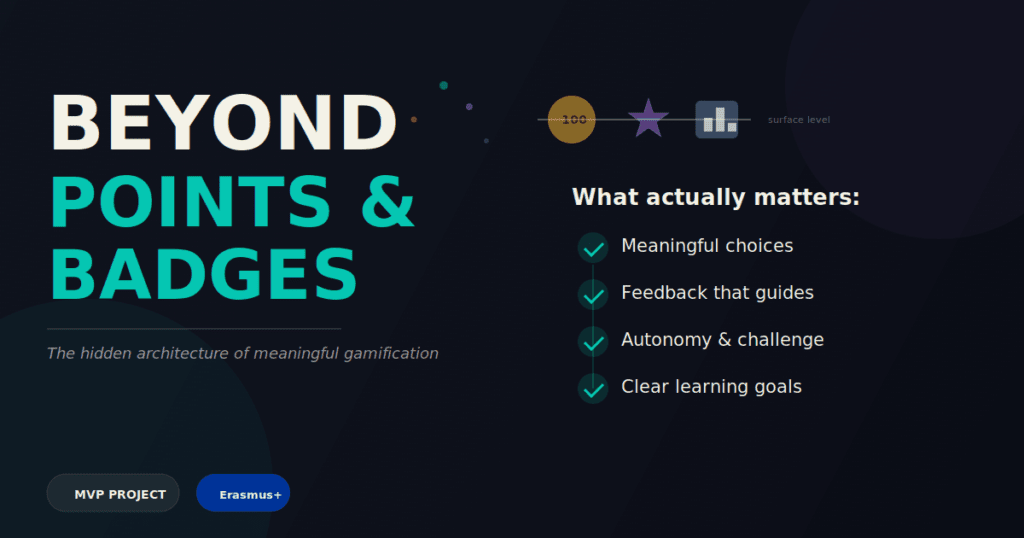
Effective gamification always starts with a clear pedagogical goal. Before adding gamification elements, it is a good idea to stop and think about what students are supposed to learn and what challenges they are currently facing in their teaching. If motivation is lacking, gamification can help spark interest. On the other hand, if the fear of failure is preventing learning, gamification can be directed towards safe practice and frequent feedback. The pedagogical goal forms the foundation on which everything else is built. Game elements support the achievement of the goal.
Meaningful choices encourage learning
Playing is strongly associated with the experience of one’s own agency. In games, choices are made that have consequences, and through them one learns. The same idea works in teaching: students can be given freedom of choice, for example, in which task they start with, how they divide their knowledge, or which path they take in learning.
If the choices are only apparent (such as choosing the color of their avatar without having an impact on learning), the student’s interest quickly fades. On the other hand, genuinely meaningful choices engage the student and make learning truly motivating.
Good feedback guides learning, not just grades
The teacher does not always have the opportunity to give immediate feedback to every student, and there is often not enough time to justify grades. The advantage of a well-designed learning game is that the feedback is fast, precise, and guiding. The student immediately gets an idea of what went wrong and how to improve their performance.
Gamified learning environments work best when feedback is provided frequently and regularly. This helps students regulate their own actions during the learning process. Complex technology is not necessary – even simple self- and peer-assessment tasks can serve as effective feedback tools.
Appropriate challenge and freedom increase motivation
According to motivation research, two factors in particular support engagement: an appropriate level of challenge and the experience of freedom. Learning games often succeed in combining these, as they can adapt to the learner’s skill level and strengthen the sense of control over their own learning.
In practice, this means tasks that are not too easy but not insurmountably difficult either. At the same time, it is good to give the student the space to work independently so that he or she can take responsibility for his or her own learning.
Gamification does not always require digital tools
Gamification can also be implemented without digital tools. Board games, role-playing games and other functional methods can work excellently as gamification tools in teaching. When digitalization is left aside, the focus is often more clearly on the pedagogical goal and not just on the spectacular implementation.
The Most Value Play platform offers tools for both digitally implemented and digitally free gamification. It helps teachers find solutions that are suitable for their own teaching.
How to sustainably introduce gamification into teaching?
The purpose of gamification is not to “trick” students into learning. Its goal is to utilize the natural human way of getting excited, experimenting and developing. Points and badges have their place, but only as part of a whole, where the pedagogical goal, appropriate feedback, appropriate challenge and freedom of choice are at the center.
When experimenting with gamification, start from the goals of the teaching. Design gamified solutions thoughtfully and remember that the goal is not just to make learning look like a game, but to make it feel as engaging as a good game.
The Most Value Play platform provides tools and operating models designed by teachers for teachers to support gamification. Most Value Play is a project funded by the European Commission (Erasmus+) and implemented by DLEARN – European Digital Learning Network, Ensinus Group, Fundació Tr@ms, HATEC SA (Human Asset) and the University of Turku.
Read more on the Most Value Play project website.