Ecosystem for learning and teaching mathematics (MOE)
MOE is a three-year development project (2021–2024) funded by the Technology Industries of Finland Centenary Foundation and the Finnish Cultural Foundation, which aims to promote the support of flexible and advanced mathematical thinking in primary school. The project is implemented by the University of Turku’s Research Institute for Learning Analytics TRILA (coordinator), the University of Turku’s Department of Teacher Education, the University of Tampere’s Faculty of Education and Culture, and the Varga-Neményi Association.
The project aims to promote mathematical competence and appreciation and to develop elements related to mathematics teaching, learning, assessment and support.
Activities and goals
The mathematics competence of primary school students has been declining for some time, and this is already visible in the fourth grade assessments, where the proportion of very low achievers has increased and the importance of social background has been emphasized.
Teaching mathematics requires teachers to have in-depth pedagogical competence, and strong learning materials are needed to support teachers’ professional development. In addition, teachers need real-time information about student learning so that they can identify and support the needs of all students. In our project, we aim to respond to these challenges by providing schools with tools and support to promote mathematics learning. Our goal is to support both low and high achievers in mathematics and to inspire students to study mathematics.
The objectives of the activity are 1) increasing the competence and appreciation of mathematics, 2) ensuring the competence of all students, and 3) developing the teaching culture of mathematics.
Ecosystem for learning and teaching mathematics
The project implements an ecosystem model of individual learning paths, which is built from four interconnected elements. The ViLLE learning system is used as the implementation environment.
- Development of learning paths in primary school general education using high-quality pedagogy and differentiation of teaching upwards and downwards within general education
- Development of three-tier support using research-based Briefcases Of Special Support
- Tools for assessing learning, competence development and support needs based on learning analytics and nationally standardized assessment tasks
- Situation analysis that provides teachers with real-time information about their own students and tools for information management for school and educational administration
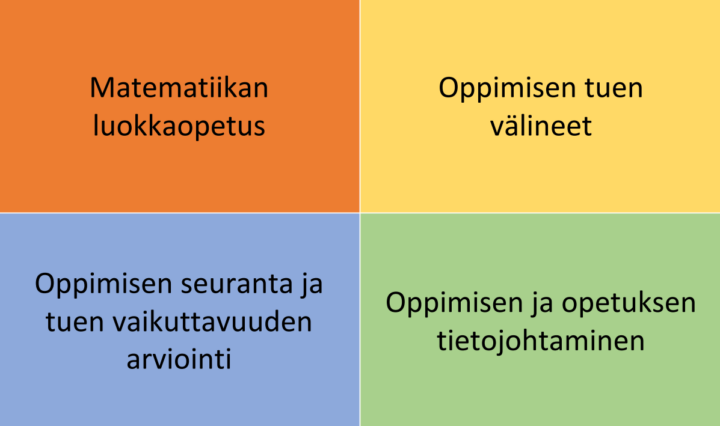
An ecosystem for learning and teaching mathematics, i.e. a multidisciplinary implementation model for research-based learning paths
Results form the project
Learning paths
ViLLE is a digital learning platform developed and maintained by the Research Institute for Learning Analytics at the University of Turku, and learning paths are ready-made, year-round task sets designed for different subjects, based on automatic assessment and immediate feedback. During the MOE project, the Mathematics learning paths for grades 3-6 will be renewed by adding new content and task types and by developing the learning analytics included in learning paths. After the reform, students’ tasks will be more diverse and the information received by the teacher about the student’s development areas will be more accurate. Attention has also been paid to the mobile functionality of learning paths, so that the content would be as easy to use as possible on different devices.
- Mathematics study path, 3rd grade
- Mathematics study path, 4th grade
- Mathematics study path, 5th grade
- Mathematics study path, 6th grade
Task sets following the VaNe method
The year-specific courses according to the Varga-Neményi method are designed primarily to serve teachers who use the method and their students. ViLLE tasks provide material for developing and automating students’ arithmetic skills after the matter has been studied in class according to the abstraction path included in the method.
On the other hand, the specific courses that are not tied to year groups are also well suited for developing arithmetic skills and can also be used with other teaching methods when material is needed to practice, improve fluency and automate arithmetic skills. The course tasks progress in small steps from easier to more difficult strategies.
The Varga-Neményi Association is responsible for the content of the tasks.
- Varga-Neméneyi Method, 1st Grade (Fall and Spring)
- Varga-Neméneyi Method, 2nd Grade (Fall and Spring)
- Varga-Neméneyi Method, 3rd Grade (Fall and Spring)
- Varga-Neméneyi Method, 4th Grade (Fall and Spring)
- Counting Strategies (0–20 and 0–100)
- Multiplication and Division (2–5 and 10; 6–9)
Matikkakeidas
Matikkakeidas is a new mathematics learning environment in ViLLE that develops flexible mathematical thinking, contains diverse tasks and learning games, and includes teacher instructions. Matikkakeidas allows students to try out different ways of solving problems, learn to justify their own solutions and find errors, and observe mathematics in everyday situations familiar to students and under the guidance of a teacher. The tasks also require a lot of pen and paper, and the teacher plays a central role as a guide for Matikkakeidas.
The authors of Matikkakeidas are from the Mathematics Learning and Teaching Research Group of the Department of Teacher Education at the University of Turku and the Faculty of Education and Culture at the University of Tampere.
- Matikkakeidas 1.–2. luokka
- Matikkakeidas 3.–4. luokka
- Matikkakeidas 5.–6. luokka
Briefcases Of Special Support (BOSS)
Briefcases Of Special Support are task sets designed for special education needs, especially for students who have challenges in basic mathematics or mother tongue skills. The content is not tied to year groups, and the tasks focus on only one learning topic at a time. The tasks have been developed by the Research Institute for Learning Analytics.
- Perception of time
- Number system and number sequence
- Addition and subtraction
- Multiplication tables
- Division
- Fractions
- Percentages
- Measurement and unit conversions
Standardized assessment
We develop electronic assessment tools for mathematics and reading skills as multi-university and multidisciplinary collaborative projects. The assessment tools are developed on a research-based basis. The goal is to produce bilingual, high-quality and reliable assessment tools for Finland that measure the competence and development of basic skills and the application of basic skills. The assessments are currently carried out in cooperation with municipalities annually to monitor the learning progress of tens of thousands of students and identify learning challenges.
- Numeracy and Mathematics
- Literacy and Language Skills
More information
For more detailed information about the materials produced during the project and the related research, please contact the leader of each sub-project. Inquiries regarding the entire project can be directed to the responsible project leader, Mikko-Jussi Laakso.